


If you own a short-term rental, you’ve probably heard about the IRS’s 100-hour material participation test. On paper, it sounds simple: work more than 100 hours on your rental during the year, and make sure no one else worked more hours than you. In practice, applying that rule is a lot messier than it sounds.
Every short-term rental is operated differently. Some owners do everything themselves. Others lean on a cleaner or two. Many hire a full-service property manager, and some property managers subcontract out nearly every task to a rotating cast of vendors. Each of these staffing models changes how the 100-hour test plays out — and changes what kind of documentation an owner needs to defend their position.
This article walks through six hypothetical scenarios that illustrate how different operating models can affect the material participation analysis. These examples are simplified for illustration purposes only. They are not a substitute for a real analysis of your own facts. Whether any specific owner actually qualifies for material participation depends on the hours actually worked, the nature of those hours, thorough documentation, and all of the applicable IRS rules — not just the 100-hour threshold in isolation.
If you’re unfamiliar with the IRS material participation rules, first read our guide on STR Material Participation: Qualifying Activities That Count Toward the IRS Tests.

Example 1: A Fully Self-Managing Airbnb Owner
Sarah owns a single Airbnb property. She doesn’t use a property manager, and she doesn’t have a regular cleaner. Instead, she calls in specialty contractors only when something specific needs attention — a plumbing issue, an appliance repair, or a seasonal HVAC tune-up.
On a week-to-week basis, Sarah’s involvement looks like running a small business. She answers guest messages and handles booking questions. She adjusts nightly pricing based on demand and local events. She schedules reservations and blocks off dates for her own use or for maintenance. Between guest stays, she cleans the unit herself, restocks supplies, and does a quick walkthrough to catch anything that needs attention before the next check-in. When something breaks, she’s the one who meets the contractor at the property and reviews the work.
Participation analysis: Because so few other people touch this property, Sarah’s participation analysis is relatively straightforward compared to the examples that follow. There’s no property manager whose hours she needs to track and compare against her own, and no recurring cleaner whose time might rival hers. The main comparison points are the occasional specialty contractors, whose visits tend to be short and infrequent relative to Sarah’s ongoing involvement.
Takeaway: An owner in Sarah’s position may have a reasonable basis for satisfying the 100-hour test, provided she actually exceeds 100 qualifying hours over the course of the year and satisfies all other applicable IRS requirements — including keeping the kind of records that would hold up if her return were ever reviewed.
Example 2: An Owner Who Uses Multiple Independent Service Providers
Now consider an owner who has built out a small team of independent contractors: two different cleaners (Cleaner A and Cleaner B, perhaps rotating based on availability), a pool company, a lawn service, a handyman, and a separate laundry service.
Even with this much outside help, the owner still carries a meaningful workload. She manages all guest communication, from inquiries through checkout. She conducts periodic inspections to make sure the property is being maintained to standard. She purchases inventory and supplies. She reviews repair requests and approves the vendors who will handle them, and she’s the one who meets contractors on-site when needed.
Participation analysis: This scenario is more complicated than Example 1, but for a different reason than you might expect. Because the work is spread across several individuals rather than concentrated in one property manager, no single outside person necessarily performs substantially more work than the owner. That can actually work in the owner’s favor because the comparison under the 100-hour test focuses on whether another individual participates more than the taxpayer, rather than simply comparing the taxpayer’s hours to the combined workload performed by multiple service providers.
That said, whether this owner ultimately qualifies still depends on her actual participation, her documentation of both her own hours and the hours of each service provider, and her total hours for the year. Splitting tasks across multiple providers doesn’t automatically solve the participation question; it just changes who the owner needs to compare herself against.
Takeaway: Spreading work across several independent contractors can reduce the risk that any one person “out-participates” the owner, but it increases the recordkeeping burden. The owner needs a reasonable sense of how much time each provider is spending, not just her own hours.
Example 3: Working With a Property Management Company
This is often the scenario owners worry about most, and it deserves the closest look.
In this arrangement, a property management company handles the guest-facing side of the business: bookings, the calendar, guest messaging, and scheduling vendors for routine turnovers and repairs. The owner, meanwhile, stays involved on the operational and strategic side. She conducts weekly inspections of the property. She reviews and approves contractor bids before work begins. She handles supply purchasing for larger items. She reviews the property’s budget and financial performance, and she takes the lead on renovation planning and capital improvement decisions.
Participation analysis: Hiring a property manager does not automatically prevent an owner from materially participating. The 100-hour test asks whether the owner’s hours are at least equal to those of any other individual — it doesn’t disqualify an owner simply because a management company exists. The real question is how the work is actually divided in practice.
If the property manager is handling the bulk of the day-to-day operational hours — bookings, guest messaging, coordinating routine turnovers — those hours can add up quickly and may exceed what the owner spends on inspections, approvals, and planning. On the other hand, if the owner retains substantial hands-on responsibilities like weekly inspections, active vendor oversight, and hands-on capital improvement work, her hours may still be competitive. This is exactly the kind of situation where the specifics matter far more than the general arrangement, and where contemporaneous documentation of both parties’ time becomes especially important.
Takeaway: A property manager relationship doesn’t settle the material participation question one way or the other. It simply means the owner needs a clear understanding of how participation is distributed among the individuals performing services for the activity.
Example 4: Property Manager Coordinates Multiple Subcontractors
This is the most layered of the six examples, and it’s worth spending extra time on because it reflects how many larger or more “hands-off” STR operations are actually structured.
Here, the property manager doesn’t just handle bookings and messaging — she also coordinates an entire roster of subcontractors: two cleaners, a laundry service, landscaping, a pool company, pest control, HVAC, an electrician, and a plumber. On paper, it can look like almost the entire operation runs through the property manager and her network.
Despite that, the owner remains meaningfully involved. She still conducts weekly inspections. She approves vendors before they’re hired. She handles supply purchases. She participates in budget meetings and takes the lead on property improvements and larger maintenance decisions.
Participation analysis: This example illustrates how layered staffing arrangements can make the 100-hour material participation analysis more complex. While the property manager oversees the operation, multiple individuals may perform services for the property, each contributing different amounts of time. To evaluate the 100-hour test, the owner should understand who is performing the work, approximately how much each individual participates, and how that compares with the owner’s own participation. Whether the owner satisfies the test depends on the actual facts, the hours worked by each participant, and the documentation supporting those hours.
Practical lesson: Owners working with a property management company should have a clear understanding of who performs the day-to-day operational work, what responsibilities remain with the owner, and how participation is distributed among the individuals involved. Maintaining records of the owner’s own activities—and communicating with the property manager about operational responsibilities—can make it easier to evaluate material participation with a qualified tax professional.
Example 5: Seasonal Vacation Rental
Not every STR operates year-round. Consider an owner whose property is a summer rental that sits mostly unused, aside from maintenance, during the winter months.
During the rental season, the owner’s time is dominated by the same activities seen in the earlier examples: guest communication, pricing adjustments, inspections, and maintenance between stays. During the off-season, the nature of the work shifts. This is when the owner might tackle renovations, replace worn furniture, meet with contractors to plan upcoming projects, perform preventive maintenance, and manage inventory for the following season.
Participation analysis: Material participation is measured across the full tax year, not just the active rental season. Certain off-season operational activities may count toward material participation if they are directly connected to operating the short-term rental activity and otherwise qualify under the IRS rules.
Takeaway: Seasonal owners shouldn’t assume their participation clock only runs during the months guests are actually staying at the property. Off-season planning, maintenance, and improvement work can be a meaningful part of the total picture, provided it’s properly documented alongside in-season activity.
Example 6: When the Owner Does NOT Meet the Test
It’s just as important to see an example where the test isn’t satisfied, because the 100-hour test has two requirements — not one.
In this scenario, the owner logs 110 hours over the course of the year — comfortably above the 100-hour threshold. But the property also has a dedicated cleaner and a property manager involved. When all the hours are tallied, the property manager’s involvement turns out to exceed the owner’s 110 hours.
Why this matters: Clearing 100 hours is necessary, but it isn’t sufficient on its own. The second half of the test requires the owner’s participation to be at least as much as that of any other individual. In this example, the owner satisfied the first half of the test and failed the second.
Lesson: The 100-hour test is a two-part test, and owners who focus only on hitting the hour count while losing track of how much time their property manager or staff are spending can end up short — even with what looks, at first glance, like a solid number of hours.
Key Lessons From These Examples
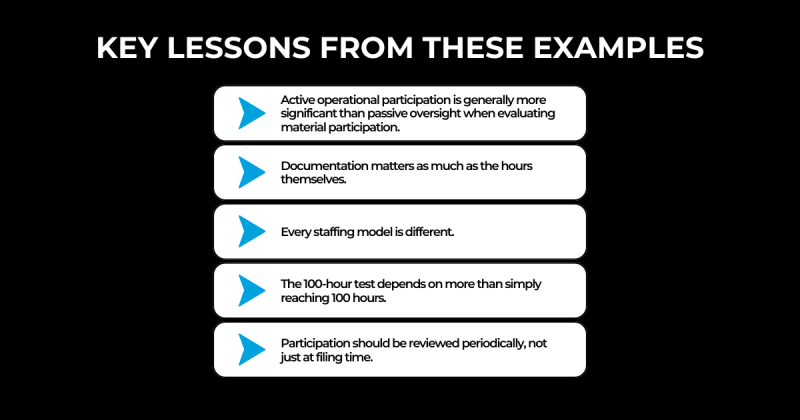
Taken together, these six scenarios point to a few consistent themes:
- Active operational participation is generally more significant than passive oversight when evaluating material participation. Reviewing reports or approving decisions from a distance is different from being actively involved in day-to-day operations.
- Documentation matters as much as the hours themselves. Several of these examples turn on comparisons between the owner and other individuals — comparisons that are only defensible if both sets of hours are tracked.
- Every staffing model is different. Self-managing, working with independent contractors, using a property manager, and layering subcontractors under a property manager all create different comparison points under the 100-hour test.
- The 100-hour test depends on more than simply reaching 100 hours. As Example 6 shows, exceeding the threshold is only half the analysis.
- Participation should be reviewed periodically, not just at filing time. Staffing arrangements change during the year, and an owner’s standing relative to a property manager or contractor can shift along with them.
How REPSLog Can Help
Every example above ultimately comes down to the same three things: hours, activities, and documentation. Knowing roughly how many hours you spent, what those hours were actually spent doing, and being able to show it later are the building blocks of a defensible material participation position — regardless of which staffing model you use.
REPSLog is built to help STR owners organize all three. Instead of trying to reconstruct a year’s worth of activity from memory at tax time, REPSLog gives owners a way to log hours and activities as they happen, making it easier to see where they stand relative to their property manager, cleaners, or other contractors throughout the year.
Conclusion
These six examples demonstrate that there is no single path to satisfying the 100-hour material participation test. Some owners self-manage, others work alongside contractors or property managers, and every operating model presents different considerations. Understanding how your participation compares with the participation of others — and maintaining accurate records throughout the year — can help you and your tax professional evaluate whether the test has been met. Firms that focus specifically on real estate taxation, such as Compass CPA, can be a useful resource for STR owners working through these comparisons alongside their own recordkeeping.


